Joint Pain and Stiffness During Midlife: What Women May Notice and What May Be Related
During midlife, some women may notice that their joints feel more painful, stiff or uncomfortable than they did before.
For some women, the change may be occasional. For others, pain or stiffness may seem to occur more often or become more noticeable during everyday activities. Some women may notice little or no meaningful change at all.
Joint pain and stiffness can occur in many different circumstances. Midlife can also coincide with reproductive aging, changes in overall health and other individual circumstances.
Noticing joint pain or stiffness during this stage therefore does not, by itself, explain why those symptoms are occurring.
What Do Joint Pain and Stiffness Mean?
Joint pain describes pain or discomfort experienced in or around a joint.
Joint stiffness describes a feeling that a joint is less comfortable or more difficult to move than usual.
A woman may experience pain without much stiffness, stiffness without significant pain, or both at the same time.
The intensity, duration and location of these symptoms can also vary. They may involve one joint or more than one joint and may be occasional or more persistent.
Neither symptom identifies its cause on its own.
Joint pain and stiffness are symptoms, not explanations.
Joint Pain and Stiffness Can Become More Noticeable During Midlife
Some women may notice that joint pain or stiffness becomes more apparent during midlife.
A joint may feel less comfortable than before, stiffness may become more noticeable, or existing symptoms may attract more attention during this stage of life.
However, women do not experience one universal pattern of joint symptoms during midlife.
Several changes can occur during the same period. Reproductive aging may overlap with changes related to aging, overall health and other individual circumstances.
For this reason, a woman cannot determine the cause of joint pain or stiffness from her age or life stage alone.
Why Midlife Does Not Point to a Single Explanation
When joint symptoms appear or become more noticeable during midlife, it can be tempting to connect the timing of those symptoms directly with this stage of life.
But timing does not establish cause.
Midlife is a broad period during which reproductive, physical and health changes may occur. Their relevance varies between individuals, and more than one factor may be present at the same time.
Joint pain and stiffness also occur in many contexts outside the menopausal transition.
The fact that these symptoms begin or become more noticeable during midlife therefore does not establish that midlife itself is responsible.
The timing of joint pain or stiffness during midlife does not establish its cause.
How the Menopausal Transition May Be Related to Joint Pain and Stiffness
Muscle aches and joint pains are among the physical changes reported by some women during perimenopause and menopause.
Research has also found associations between menopausal stage and musculoskeletal symptoms in groups of women.
These findings make the menopausal transition relevant when discussing joint symptoms during midlife, but they do not provide an individual explanation for why a particular woman's joints hurt or feel stiff.
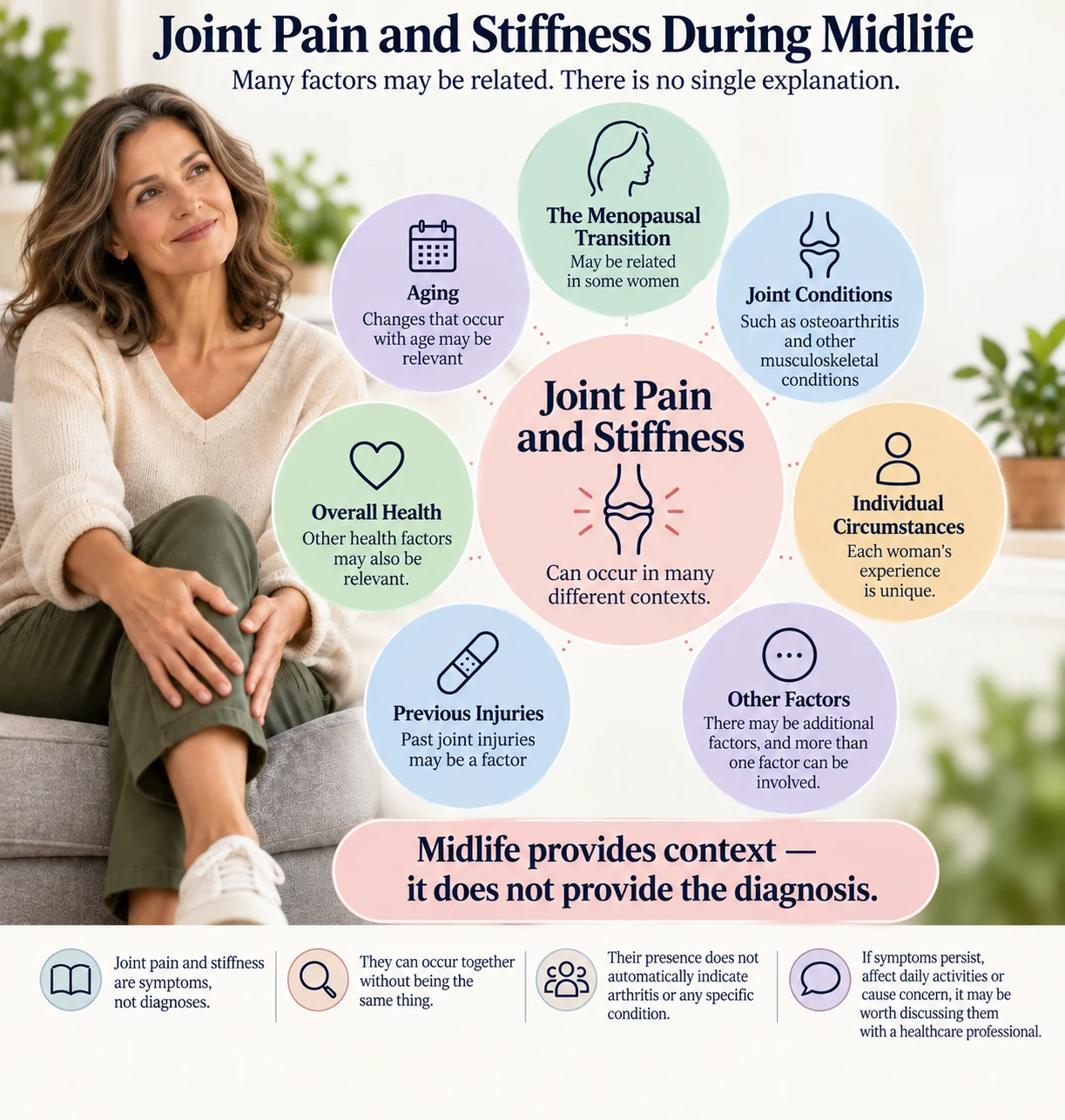
Age, joint conditions, overall health and other individual circumstances may also be relevant.
The presence of joint pain or stiffness during the menopausal transition therefore should not automatically be attributed to menopause or hormonal changes.
The menopausal transition may be part of the context without providing the individual explanation.
Pain and Stiffness Can Occur Together Without Being the Same Thing
Joint pain and joint stiffness are related experiences, but they are not interchangeable.
Pain describes discomfort. Stiffness describes a sensation of reduced ease or comfort when moving a joint.
A woman may experience both symptoms in the same joint, but the presence of one does not necessarily mean that the other will also be present.
Keeping the symptoms separate is useful because describing an experience accurately provides more information than treating all joint changes as the same thing.
It also prevents either pain or stiffness from appearing more diagnostically specific than it is.
Pain and stiffness can occur together without identifying a single cause.
Different Factors May Be Related to Joint Pain and Stiffness
Joint pain and stiffness can occur in different contexts, and there is no single explanation that applies to every woman who experiences them.
Joint and musculoskeletal conditions, overall health and individual circumstances are among the areas that may be relevant when persistent or unexplained symptoms are considered.
The presence of one of these factors does not establish that it caused the symptoms in an individual woman.
Joint Conditions and Other Musculoskeletal Factors
Different joint and musculoskeletal conditions can involve pain or stiffness.
Osteoarthritis, for example, can involve joint pain and stiffness, but experiencing those symptoms does not establish that osteoarthritis is present.
Different conditions can produce overlapping symptoms, and the same type of discomfort may occur in more than one context.
Where a joint hurts, how the symptoms develop and other characteristics may provide useful information during a clinical assessment, but they should not be interpreted individually as diagnostic rules.
Joint pain or stiffness alone cannot determine whether arthritis or any particular joint condition is present.
Overall Health and Individual Circumstances
Joint symptoms can also be considered within a woman's broader health and individual circumstances.
Age, previous joint problems, injuries, overall health and other individual circumstances may be relevant in different situations.
Their importance will not be the same for every woman, and the presence of a particular factor does not prove that it explains her symptoms.
The purpose of considering the broader context is therefore not to create a list of possible diagnoses.
Instead, it reinforces an important boundary: similar joint symptoms can occur in different circumstances and may have different explanations.
Why Joint Pain or Stiffness Alone Cannot Tell You the Cause
Joint pain and stiffness tell a woman what she is experiencing, but they do not necessarily explain why she is experiencing it.
Details such as which joints are affected, whether pain and stiffness occur together, how long the symptoms have been present and how they affect movement or everyday activities can provide useful information during a clinical assessment.
Those details, however, should not be interpreted individually as diagnostic rules.
A particular location, pattern or time of day does not, by itself, establish one explanation.
The same principle applies to age, midlife and the menopausal transition.
A symptom can be meaningful without identifying its cause.
When Is It Worth Discussing Joint Pain or Stiffness With a Healthcare Professional?
If joint pain or stiffness persists, becomes difficult to manage, repeatedly returns, affects everyday activities or is causing concern, discussing the symptoms with a healthcare professional may be appropriate.
A conversation may also be useful when the reason for the symptoms is unclear or when they occur alongside other changes a woman has noticed.
Seeking professional advice does not mean that arthritis or another particular condition is necessarily present.
It allows the affected joints, symptoms, health history and individual circumstances to be considered together rather than assuming that midlife, menopause or any other single factor explains the change.
Joint pain and stiffness during midlife can be meaningful without having one universal explanation.
Midlife provides context — it does not provide the diagnosis.
Explore Women's Midlife Health
Midlife can affect different areas of health in different ways. Return to the main hub to explore other evidence-informed guides.
Sources
- Kruse C, et al. Musculoskeletal Manifestations of Perimenopause: A Systematic Review and Meta-Analysis of 93,021 Women. JB & JS Open Access. 2026. PubMed
- NHS. Menopause and perimenopause symptoms. NHS
- NHS. Joint pain. NHS
- National Institute of Arthritis and Musculoskeletal and Skin Diseases. Osteoarthritis. NIAMS
- Watt FE. Musculoskeletal pain and menopause. Post Reproductive Health. 2018. PubMed