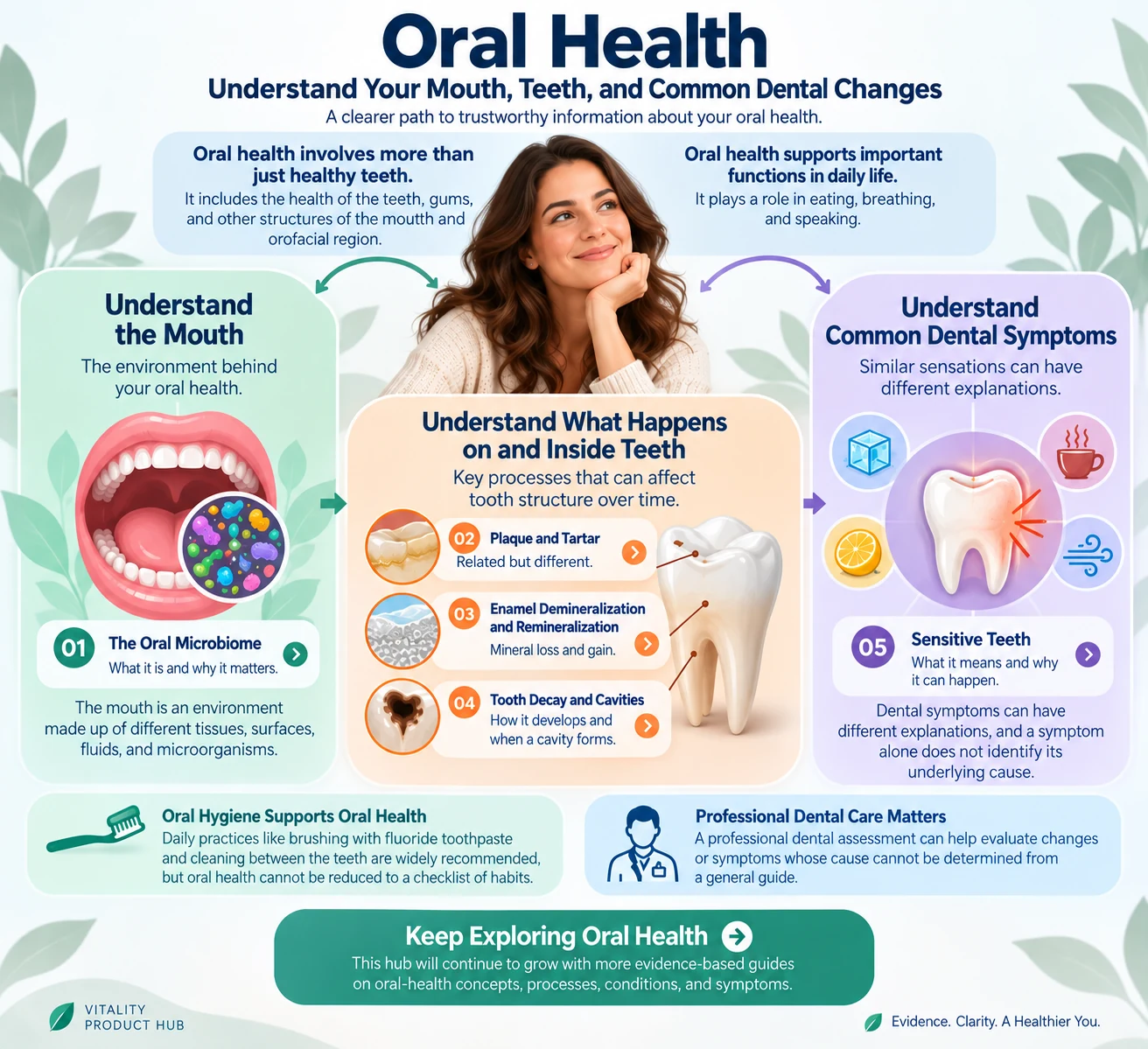
Oral health involves more than whether your teeth look healthy or whether your mouth feels comfortable.
It includes the health of the teeth, gums, and other structures of the mouth and orofacial region, as well as functions such as eating, breathing, and speaking.
Oral hygiene is an important part of caring for the mouth, but oral health and oral hygiene are not the same thing.
This Oral Health hub brings together our growing collection of evidence-based guides designed to help you understand important oral-health concepts, tooth processes, and dental symptoms — without turning a symptom into a diagnosis.
What Does Oral Health Include?
Oral health is a broad area that includes teeth, gums, and other structures of the mouth and surrounding orofacial region.
Understanding oral health therefore requires looking beyond a single tooth or a single condition.
Oral Health Is More Than Healthy Teeth
Teeth are an important part of oral health, but they are not the entire picture.
Oral health involves different tissues and structures of the mouth, not teeth alone. Changes in one part of this environment do not automatically explain what is happening elsewhere.
For the same reason, the appearance of teeth alone cannot establish the overall state of a person's oral health.
Oral Health and Oral Hygiene Are Related — but Not the Same Thing
Oral hygiene refers to practices used to care for the mouth. Oral health is the broader health territory those practices are intended to support.
Daily practices such as brushing with fluoride toothpaste and cleaning between the teeth are widely recommended components of oral care.
But oral health cannot be reduced to a checklist of hygiene habits. Professional dental assessment can help evaluate changes or symptoms whose cause cannot be determined from a general guide.
Understand the Mouth
Understanding oral health begins with recognizing that the mouth is an environment made up of different tissues, surfaces, fluids, and microorganisms.
The Oral Microbiome
The mouth contains diverse microbial communities living on different surfaces and in different oral niches.
The term oral microbiome describes this complex microbial ecosystem. It should not be reduced to a simple battle between “good” and “bad” bacteria, and changes in the microbiome do not automatically mean disease.
Our guide explains how microbiome, microbiota, and biofilm relate — and where their meanings differ.
Understand What Happens on and Inside Teeth
Several oral-health concepts involve changes occurring on tooth surfaces or within existing tooth structure.
Dental Plaque and Tartar
Dental plaque is a microbial biofilm that adheres to tooth surfaces. Tartar — also called dental calculus — is a mineralized deposit.
Plaque and tartar are therefore related but different, and the distinction matters when understanding how each can be controlled or removed.
Enamel Demineralization and Remineralization
Tooth enamel can undergo mineral loss and mineral gain.
Demineralization involves mineral loss, while remineralization involves mineral gain within structurally present enamel.
Remineralization does not mean that enamel tissue that has already been physically lost simply grows back.
Our guide explains the distinction without treating remineralization as enamel regeneration.
Tooth Decay and Cavities
Tooth decay, or dental caries, is a dynamic, multifactorial disease process.
A cavity is one possible structural result of that process, but early tooth decay and a cavity are not the same thing. Early caries does not automatically mean that a visible hole has already formed.
Our guide looks at how the caries process develops and why progression is not inevitable.
Tooth Erosion and Erosive Tooth Wear
Tooth erosion is an acid-related process that can affect mineralized tooth structure. It is different from tooth decay, even though both processes can involve mineral loss.
Our guide explains how erosive tooth wear develops, how acid exposure and mechanical influences can interact, and why erosion should not be confused with cavities or every form of tooth wear.
Bruxism, Teeth Grinding, and Jaw Clenching
Bruxism involves jaw-muscle activity that can occur during wakefulness or sleep, and it is broader than teeth grinding alone.
Our guide explains the difference between awake and sleep bruxism, why tooth wear or jaw symptoms alone cannot identify bruxism, and why grinding and clenching need to be understood in context.
Understand Common Dental Symptoms
Dental symptoms can have different explanations, and a symptom alone does not identify its underlying cause.
That distinction is particularly important when different dental conditions can produce similar sensations.
Sensitive Teeth and Tooth Sensitivity
Cold water, a hot drink, sweet or acidic foods, air, or touch can sometimes provoke tooth sensitivity.
But sensitive teeth describe a symptom — not a single diagnosis.
Several dental conditions can produce similar sensitivity, which is why the trigger alone cannot establish the cause.
Dentin hypersensitivity is a more specific clinical condition and should not be used as a synonym for every sensitive tooth.
Canker Sores and Mouth Ulcers
A canker sore is one type of mouth ulcer, but not every oral ulcer is a canker sore.
Our guide explains the difference between canker sores and other mouth ulcers, what recurrent aphthous stomatitis means, and why recurrence or appearance alone cannot identify the cause of an oral lesion.
Tooth Discoloration and Stains
Tooth discoloration describes a change in the color or appearance of teeth, but the color alone does not identify the cause.
Our guide explains extrinsic and intrinsic discoloration, why one tooth may look darker than the others, and why a color change does not automatically mean tooth decay, enamel damage, or tooth erosion.
Cracked Tooth
A cracked tooth is a structural dental problem, but not every visible line, episode of biting pain, or sensitive tooth means that a tooth is cracked.
Our guide explains how cracked teeth differ from craze lines, fractured cusps, split teeth, and other dental fractures, why symptoms can overlap, and why professional evaluation may require multiple findings.
Bad Breath and Halitosis
Bad breath can have different possible sources, and the odor alone does not identify where it comes from or what is causing it.
Our guide explains oral and extraoral sources of halitosis, why different findings can overlap, and how professional evaluation can help identify possible sources.
Geographic Tongue
Geographic tongue is a benign condition with a surface pattern that can change in shape, size, or location over time.
Our guide explains why the pattern can change, why symptoms can vary, and why a similar-looking tongue change cannot be identified from appearance alone.
Sugar-Free Chewing Gum and Oral Health
Sugar-free chewing gum has been studied in relation to saliva, tooth decay, dental plaque, and the oral environment — but the effects of chewing and the effects of specific sweeteners are not the same thing.
Our guide examines what the evidence shows, how xylitol differs from sugar-free gum generally, and why chewing gum remains an adjunct rather than a replacement for established oral hygiene and dental care.
Fluoride and Oral Health
Fluoride has a well-established role in preventing dental caries, but its effects are sometimes described too broadly. It can support remineralization of existing enamel and help make enamel more resistant to acid challenge — without regrowing enamel that has already been lost.
Our guide examines how fluoride reaches the teeth, what the evidence shows about fluoride toothpaste, why concentration and context matter, and how remineralization differs from enamel regeneration.
Enamel Erosion
Dental erosion occurs when non-bacterial acids repeatedly affect mineralized tooth surfaces. These acids may come from foods and drinks or from inside the body, such as gastric acid reaching the mouth.
Our guide explains how acid exposure can contribute to erosive tooth wear, how dental erosion differs from tooth decay, what signs may appear, and why reducing repeated acid exposure can help limit further tooth structure loss.
Everyday Oral Hygiene and Professional Dental Care
Daily oral hygiene is one part of caring for oral health.
General recommendations include brushing teeth with fluoride toothpaste and cleaning between teeth.
Professional dental assessment can help evaluate oral-health changes, symptoms, and individual needs that cannot be determined from a general guide.
What Daily Oral Hygiene Can — and Cannot — Tell You About Oral Health
Consistent oral-hygiene practices can help care for teeth and gums, but following a hygiene routine does not provide a diagnosis or establish that every part of the mouth is healthy.
Likewise, the absence of pain does not by itself establish the absence of an oral-health problem.
Symptoms or visible changes may sometimes require professional assessment because their cause cannot be established from a general guide alone.
Keep Exploring Oral Health
Oral health covers a much wider territory than the topics currently included in this hub.
As Vitality Product Hub expands its Oral Health library, this page will organize additional evidence-based guides covering additional oral-health concepts, processes, conditions, and symptoms.
The goal is not to turn every oral change into a diagnosis. It is to make the underlying concepts easier to understand, show where related terms differ, and help readers know when a question requires professional dental assessment.
Sources & References
- World Health Organization — Oral Health
- CDC — About Oral Health
- NIDCR — Oral Hygiene
- American Dental Association — Caries Risk Assessment and Management
- NIDCR — Tooth Decay
Last updated: September 17, 2026.